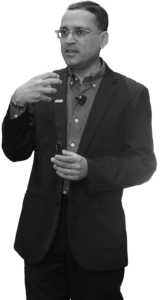
With over 20 years of experience in consulting, leadership development and teaching, Nitin Goil has become a strong advocate for creating more human-centred workplaces.Having worked in the United States, India, and Singapore, Nitin’s career spans continents, industries, and diverse perspectives. Currently, as a Senior Advisor with the NeuroLeadership Institute (NLI) in Asia Pacific and founder of Innergy Asia, Nitin’s mission is to transform how organisations approach leadership, diversity, and inclusion.
Upon relocating, Nitin transitioned into consulting, where his experience allowed him to work closely with leaders across various industries. His belief in the power of good leadership goes beyond theory—it’s about transforming entire organisations.
Leading behavioural transformation at scale
Nitin’s journey into leadership development began during his years in academia in the United States. His background in psychology and over a decade of teaching naturally led him to explore leadership development. “I was fascinated with the aspect of how leaders think, act and influence others.”
At the NeuroLeadership Institute, Nitin’s work focuses on driving behavioural change across organisations. He emphasises the transformative potential of neuroscience in leadership. “Our model for Change is Priorities, Habits and Systems and we use it to help organizations activate the right ‘habits’, aligned to their ‘Priorities’ and ‘Systems’, to drive change much faster and more effectively,” he explains. Understanding the brain’s workings is crucial to fostering cultural shifts within companies.
Nurturing ‘innergy’
Innergy Asia, Nitin’s brainchild, emerged during the pandemic as a platform to help individuals cope with isolation and disconnection. It has since evolved into a space for leadership coaching and workshops. “At Innergy Asia, I support and empower leaders to deepen their self-awareness and tap into their ‘Innergy’. In addition, I also mentor young leaders in Asia Pacific and help them shape a more purposeful and sustainable future in our society,” Nitin explains. He sees this as key and essential in the multicultural Asia-Pacific region.
Promoting DEI and empowering leaders
Diversity, equity, and inclusion (DEI) are central to Nitin’s leadership approach. “Diversity and Inclusion plays a pivotal role in today’s volatile environment. With all the change that’s happening around us at such speed, the need for ‘adapting’ faster couldn’t be more important. With that adaption, comes the aspect of ‘Inclusion’. I see, here in Asia we’re very diverse as a region and even Singapore for that matter. But, we’re still not doing very well.” he notes. More than diversity, we need to have more conversations around ‘Inclusion’. Creating a culture of Inclusion, requires Psychological Safety and it’s an intentional and conscious effort. The issue and challenge is we’re not aligning with each other on these intentional actions/ habits which will lead to a more equitable organization and society. One more aspect is that we’re not debating anymore and playing it safe. We either agree or disagree. Let’s debate better to drive Inclusion and Equity in whatever we do.
The future of leadership
One of the most significant challenges in leadership development, according to Nitin, is ensuring that the entire organisation speaks the same leadership language.
As a judge for Chief of Staff Asia’s 2024 HR Stars Awards, Nitin is at the forefront of recognising excellence in HR practices across the region. His extensive experience in leadership development and organisational culture uniquely qualifies him to evaluate innovative HR strategies that are driving transformation in today’s workplaces. For Nitin, this opportunity aligns perfectly with his commitment to fostering inclusive, human-centred work environments.
Looking ahead, Nitin remains optimistic about the future of leadership. “Emotional Intelligence is the cornerstone of leadership. Diversity and Inclusion are no longer buzzwords. They are the foundational frameworks upon which successful organizations are built. And lastly, continuous learning is not optional. It’s essential.
I strongly feel the next generation is ready. The future of leadership is a promising one. But it requires us to be intentional and proactive. We must strive to create high performing and human-centred organizations at the same time. And if we do so, the best is yet to come,” he asserts.